AI jewelry photography has moved fast.
Today, a jewelry brand can use many different kinds of AI tools to create product visuals. Some are general image generation tools. Some are ecommerce product photo editors. Some are AI jewelry design tools. Some are built specifically for jewelry photoshoots.
That difference matters.
If you want the short answer: FormaNova is the only tool in this list built specifically for jewelry model photography, with human-reviewed correction when AI gets it wrong. Every other tool on this list is either a general AI image model, a broad ecommerce product photo platform, or a jewelry design tool — not a jewelry photoshoot platform. The rest of this article explains exactly why that distinction matters.
GPT Image 2 and Nano Banana are not jewelry tools. They are general AI image generation and editing models. People still use them for jewelry because they are powerful and popular, but they were not built only around jewelry details like prongs, stone count, clasp logic, necklace length or earring scale.
Then there are broader ecommerce and product photography tools like Photoroom, Claid, Pebblely, CreatorKit, New Black AI, Flair AI and Caimera. These can be useful for product photos, background removal, catalog visuals, ads and lifestyle scenes. But jewelry is usually one category inside a much larger product photography system.
There are also jewelry related tools like Tashvi AI, which is closer to AI jewelry design and photorealistic jewelry renders. That is useful for creating jewelry concepts, but it is different from taking a real product image and placing that exact piece naturally on a realistic model.
Then there are tools closer to AI jewelry photography, including Photta, ProntoShoot, Media.io, Dresma and FormaNova. These tools focus more directly on jewelry visuals, model photos, try-on style images, product shots or ecommerce content.
But after seeing how jewelry brands actually use these tools, one thing becomes clear.
AI can create a beautiful image. But for jewelry, beautiful is not enough.
A jewelry image has to pass two tests. First, the jewelry must still look like the same jewelry. Second, the model must feel like a real person.
Most tools can sometimes create something nice. That is not the issue. The real question is: what happens if AI gets it wrong?
If the necklace floats, if the stone count changes, if the earring becomes too large, if the model has that obvious AI face, if the ring becomes a different ring, or if the final image is simply not good enough to post. Are you left alone to regenerate?
This is where FormaNova is different.
FormaNova is built specifically for jewelry photoshoots and supports rings, necklaces, earrings, bracelets, and watches, preserving prong geometry, stone count, and metal finish in ways that general-purpose AI photography tools do not.
When a result needs correction on FormaNova, users can raise a dispute and request a human-reviewed fix rather than reprompting blindly and spending more credits.
FormaNova treats facial structure, natural expression, and believable posture as core model realism requirements. That is the distinction between a jewelry campaign image and a generic AI render.
“AI can create a strong first draft, but jewelry still needs a creative eye. A human has to notice the tiny things: the prong direction, the stone count, the way a necklace sits on the collarbone. That creative push is what turns an AI image into a brand image.”
— Ella Roberts, Creative Director at FormaNova
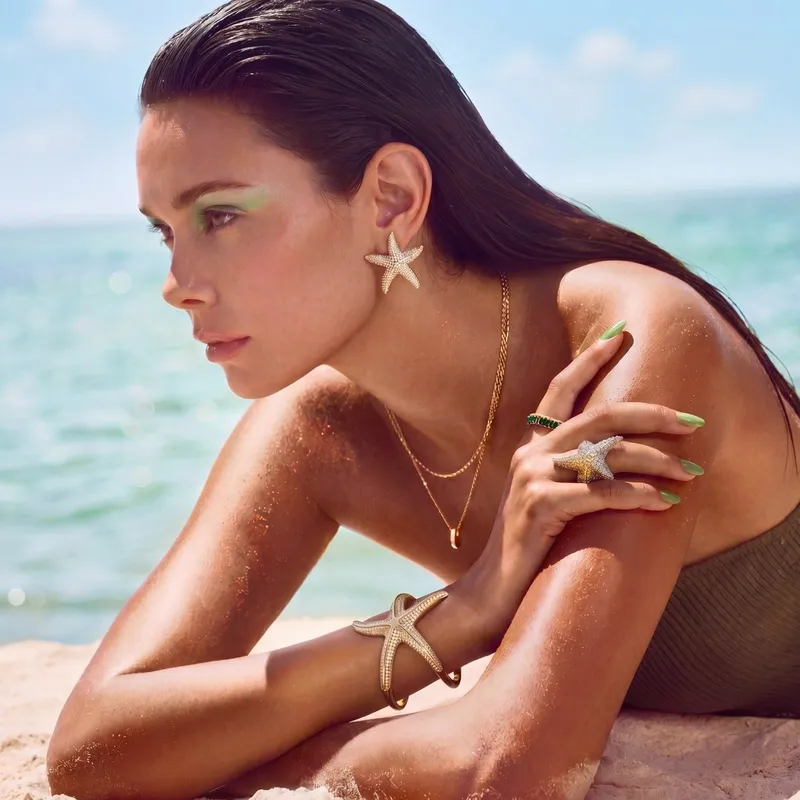
FormaNova beach campaign output with starfish jewelry. The model feels human, and the earring and bracelet sit naturally instead of looking pasted on.
Quick-reference ranking
| Rank | Tool | Jewelry focus | Model realism | Jewelry accuracy |
|---|---|---|---|---|
| 1 | FormaNova | Yes — built only for jewelry | ★★★★★ | ★★★★★ |
| 2 | Photta | Yes | ★★★☆☆ | ★★★☆☆ |
| 3 | ProntoShoot | Partly | ★★★☆☆ | ★★★☆☆ |
| 4 | Dresma | Partly | ★★★☆☆ | ★★★☆☆ |
| 5 | GPT Image 2 | No | ★★★★☆ | ★★☆☆☆ |
| 6 | Flair AI | No | ★★★☆☆ | ★★☆☆☆ |
| 7 | Claid | No | ★★★☆☆ | ★★☆☆☆ |
| 8 | Caimera | No | ★★★☆☆ | ★★☆☆☆ |
| 9 | Photoroom | No | ★★☆☆☆ | ★★★☆☆ |
| 10 | Tashvi AI | Partly (design, not photoshoot) | ★★☆☆☆ | ★★★☆☆ |
Related reading: start with what AI jewelry photography is and how it works, see our hands-on test where we tested 5 tools on one complex ring, view nine editorial looks generated from one necklace, and if you sell on Shopify, see how to export a finished photoshoot straight to a Shopify draft product.
Not every AI photo tool is built for jewelry
When people search for the best AI jewelry photography tools, they usually find a mix of very different products.
Some are general AI image tools. Some are ecommerce product photography tools. Some are jewelry design tools. Some are actual jewelry photoshoot tools.
This difference is important because jewelry is not a normal product category.
A candle can sit in a new room. A skincare bottle can be placed on marble. A handbag can be styled beside flowers.
Jewelry is different.
Jewelry is small, reflective, emotional and exact. A ring is not just a ring. It has a stone shape, prong style, band thickness, side profile, setting structure and metal finish. An earring is not just something hanging from an ear. It has a stud position, clasp, drop length, stone count, stone direction and scale. A necklace is not just a chain. It has length, weight, curve, reflection and the way it sits on the collarbone.
When AI changes these details, the image may still look beautiful. But it is not your product anymore.
That is why a jewelry-first tool matters.
FormaNova is built around jewelry accuracy, natural placement, realistic models and human-reviewed correction when the result is not right.
AI is not always wrong, but what if it is?
AI can absolutely create strong jewelry images. Sometimes the first result looks beautiful. Sometimes the jewelry sits naturally. Sometimes the model looks good. Sometimes the image is ready to post.
The point is not that AI always fails.
The point is that jewelry is a detail-sensitive category. So the real issue is not whether AI can ever get it right. The real issue is what happens when it does not.
What happens when the necklace looks pasted? What happens when the stone count changes? What happens when the model has that obvious AI face? What happens when the ring is almost right, but the setting is wrong? What happens when the bracelet turns into a different shape? What happens when the image looks nice, but not like your product?
In many tools, the answer is simple.
Regenerate. Try another prompt. Spend more credits. Start over.
That is the frustrating part.
The customer did not ask AI to change the product. The customer uploaded their jewelry and expected a usable image. If the result is wrong, they should not be left alone with a bad output.
At FormaNova, that moment matters.
If a user is not satisfied with the generation, they can raise a dispute, submit a complaint and request a human-reviewed fix. The team looks at what went wrong and works to correct the result so the image is closer to something the brand can actually use.
That is not a generic feedback loop. That is part of the FormaNova experience.
“Always have empathy for your users. Do not disappear after the generation. If a customer is left alone with a bad AI result, that is not a real product experience. Our goal was to keep the human layer alive, especially when the user feels stuck.”
— Sophia Pervez, Co-Founder of FormaNova
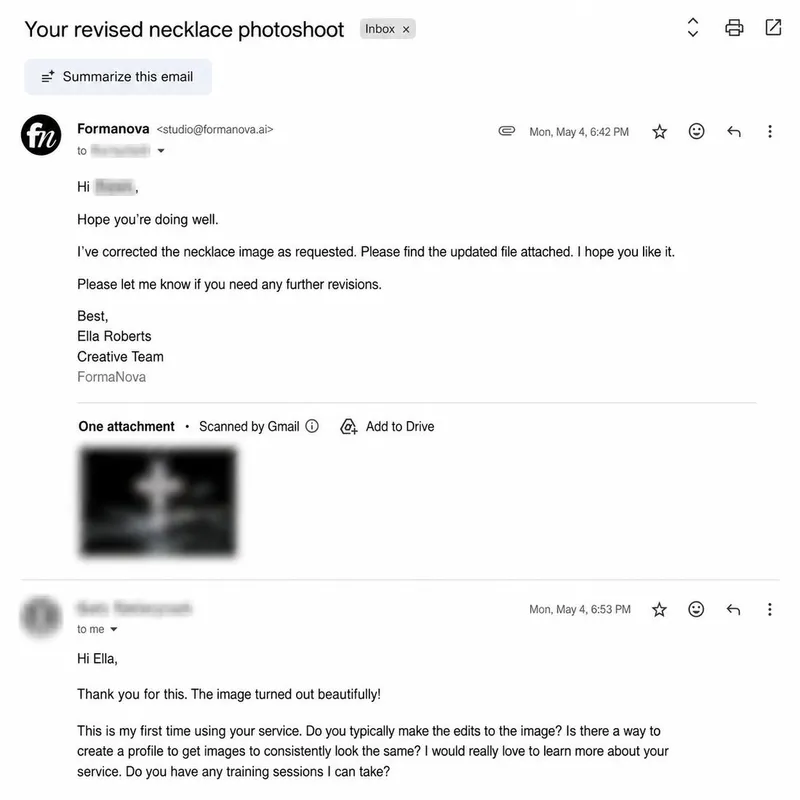
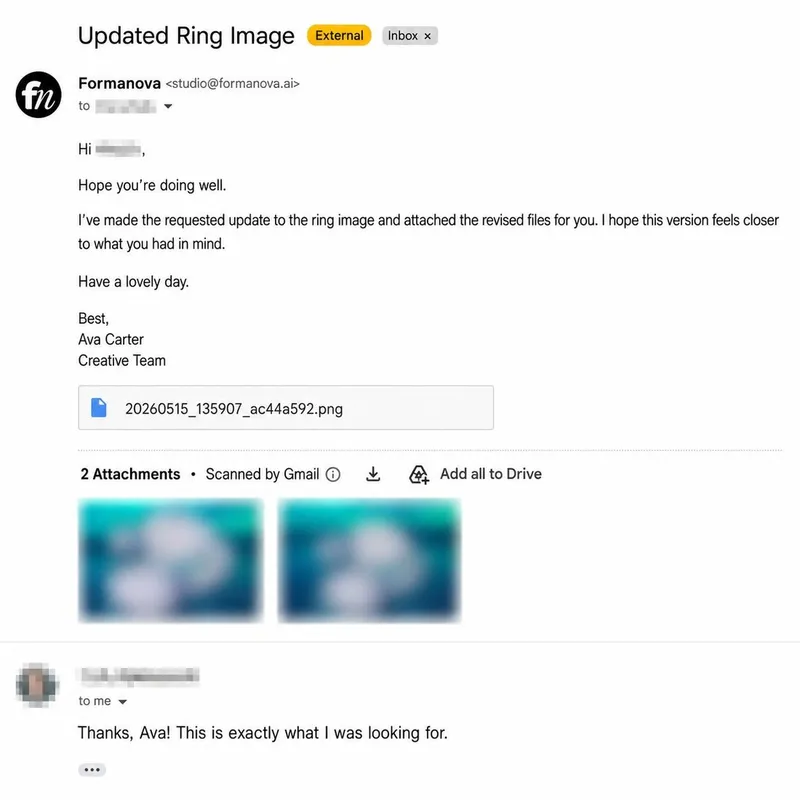
Anonymized customer correction emails from FormaNova. These are real follow-through moments after the first generation needed human review.
Curious how this looks on your own pieces? Create your own photoshoot →
The model matters as much as the jewelry
Most AI jewelry comparisons only talk about the product. Did the ring stay the same? Did the necklace change? Did the earring keep its shape? Those things matter a lot.
But there is another equally important problem.
The model often looks fake.
A lot of AI tools now claim to create realistic models. And yes, AI realism has improved. Skin texture is better. Lighting is better. Hands are better. Faces are better.
But textured skin does not automatically mean a real person.
That is where many tools get realism wrong. They add pores, eyelashes, shadows and highlights, but the model still feels off. The face looks too polished. The expression feels frozen. The smile has that typical AI perfection. The teeth look too neat. The skin has a synthetic glow. The facial structure feels familiar, like you have seen the same AI person many times before.
This is why people look at an AI model and say: something is off. It looks pretty, but not real. It looks like AI.
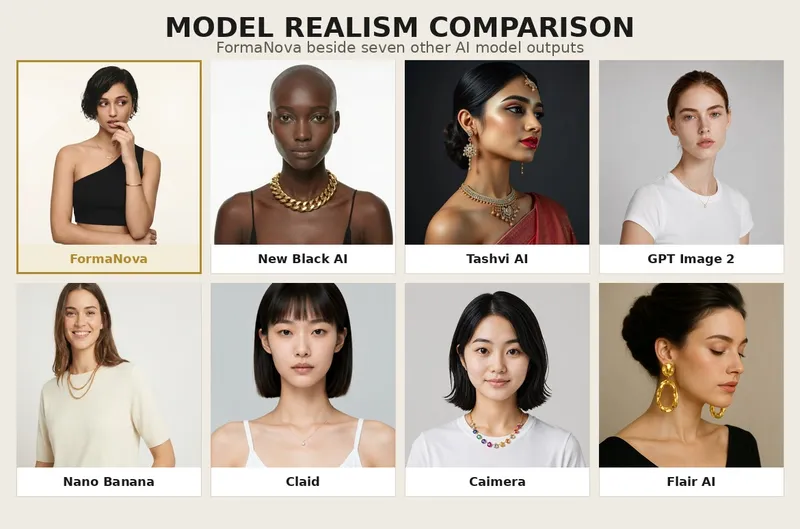
Model realism is not just skin texture. FormaNova keeps the human feeling alive. The others still have that familiar AI face when you look closely.
For jewelry brands, this matters. A premium jewelry image should feel like something you would see from a real campaign. The model should not look like a plastic beauty render. The face, posture, neck, hands and expression should feel human.
The jewelry should not be the only realistic part of the image. The person wearing it has to feel real too.
At FormaNova, model realism is treated as seriously as jewelry accuracy. The goal is not just skin texture. The goal is facial structure, natural expression, believable posture, real-looking hands, correct lighting, natural jewelry placement and small human imperfections that make the image feel alive.
“The problem with many AI model tools is that they confuse texture with realism. Realism is not just pores on the skin. It is the face structure, the expression, the way the jewelry sits, and the small human details that make you stop questioning whether the person is real.”
— Ella Roberts, Creative Director at FormaNova
We have seen this difference in customer feedback. Some brands came to FormaNova after trying other tools. They told us the images looked polished, but the models still felt synthetic. The jewelry looked clipped on. The faces had the usual AI glow. The result looked nice, but not like a real campaign.
With FormaNova, the feedback has been different. Some users have asked whether the model was a real person. Some asked whether the company had hired real models for the catalog.
That is the kind of realism FormaNova cares about. Not just good for AI. Good enough that the AI disappears and the jewelry becomes the focus.
Jewelry should not look pasted into the scene
Changing the jewelry is one problem. But there is another problem many tools miss.
Even when the jewelry is close, it can still look composited. The necklace may look like it is floating. The earring may look clipped onto the ear. The ring may not follow the finger naturally. The bracelet may not wrap around the wrist correctly. The jewelry may have different lighting from the model or background.
This is where an image starts to feel fake.
At FormaNova, we pay close attention to whether the jewelry feels like it was always part of the scene. The lighting, shadows, reflections, scale, contact with skin and placement all matter.
A necklace should follow the neck. An earring should attach correctly to the lobe. A ring should sit naturally on the finger. A bangle should wrap around the wrist. The product should not look like a sticker placed on top of a model.
The goal is simple. The jewelry should feel naturally worn.
FormaNova gives users both options: AI speed and human creative support
FormaNova is not limited to one workflow.
Users can generate jewelry photos instantly with AI through the self-serve studio. This is useful for fast model shots, product shots, ecommerce images, social content, ads and creative testing.
But if a brand wants more control, FormaNova also offers a human-powered workflow through its premium creative service for high-end brands. In this workflow, the team helps with model choice, pose direction, brand mood, jewelry accuracy and final quality checks.
So users are not forced to choose between slow traditional photography and cold AI generation.
With FormaNova, they can start with AI for speed, and use human creative support when the image needs more care, more accuracy or a campaign-level finish.
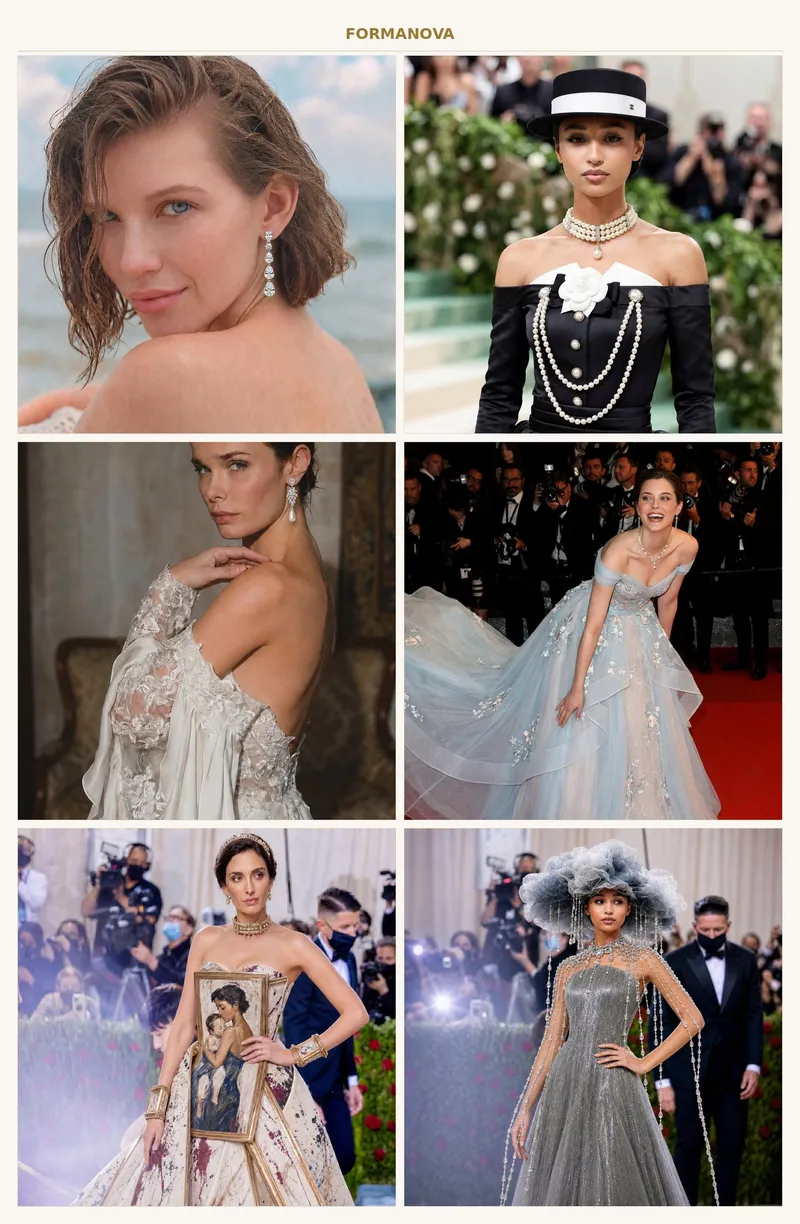
A broader set of FormaNova outputs across editorial, bridal, red carpet, and campaign styling. Different moods, same goal: realistic models and jewelry that still feels true to the product.
This is important because not every jewelry image has the same purpose. A quick product launch may need speed. A hero campaign may need creative direction. A luxury collection may need more control. A sensitive product may need human review for scale, placement and realism.
FormaNova gives jewelry brands both paths. Generate instantly with AI, or work with the human creative team when the result needs more control.
Broad AI tools vs jewelry-first AI tools
| Tool | Category | Is jewelry the main focus? | Model realism | Jewelry accuracy | What happens if AI gets it wrong? |
|---|---|---|---|---|---|
| FormaNova | Jewelry-first AI photoshoot platform with human creative support | Yes | 5/5 — Built for real-looking humans, not plastic AI faces or repeated generic model looks | 5/5 — Focused on stones, prongs, metal color, scale, placement and product identity | 5/5 — Users can generate with AI, request a human-reviewed fix, or use the premium service workflow for human-guided results |
| GPT Image 2 | General AI image generation and editing model | No | 4/5 | Powerful, but not built around jewelry accuracy — 2/5 | User usually prompts again or manually revises |
| Nano Banana | General AI image generation and editing model | No | 4/5 | Useful for creative experiments, but not built around product preservation — 2/5 | User usually regenerates or edits again |
| Photoroom | Broad ecommerce product photography tool | No | 2/5 | Useful for product visuals and backgrounds, not exact worn jewelry placement — 3/5 | User edits, regenerates or adjusts manually |
| Claid | Broad AI product photography and editing tool | No | 3/5 | Jewelry is one use case inside a broader product photo system — 2/5 | User usually adjusts, regenerates or follows general support flow |
| Flair AI | Broad AI product photography and design platform | No | 3/5 — Has on-model photography but fashion and ecommerce focused | 2/5 — Jewelry is one of many product categories alongside fashion, beauty and food | User adjusts via drag-and-drop editor or regenerates |
| Caimera | Broad AI fashion model and ecommerce photography platform | No | 3/5 — Primarily optimized for clothing and fashion models | 2/5 — Jewelry and accessories are secondary to the clothing and fashion focus | User regenerates or follows platform workflow |
| Pebblely | Broad AI product photography tool | No | 2/5 | Better for backgrounds and scenes than exact worn jewelry — 2/5 | User regenerates or adjusts |
| CreatorKit | Broad ecommerce creative and product photo tool | No | 2/5 | Jewelry is one category among many ecommerce categories — 2/5 | User regenerates or edits |
| Tashvi AI | AI jewelry design and render tool | Partly | 2/5 | Better for concepts and renders than preserving an existing uploaded product on a model — 3/5 | User follows design or render workflow |
| Photta | AI jewelry model and try-on tool | Yes | 3/5 | Jewelry focused, but fine details may still drift — 3/5 | User usually regenerates |
| ProntoShoot | AI product photography with jewelry shoot pages | Partly | 3/5 | Jewelry placement and scale may still need correction — 3/5 | User follows platform workflow |
| Media.io | Broad AI media platform with jewelry generators | Partly | 3/5 | Fine jewelry details may change or simplify — 2/5 | User usually regenerates or edits again |
| Dresma | Ecommerce visual platform with jewelry use case | Partly | 3/5 | Useful for ecommerce visuals, but not centered on human-reviewed jewelry fixes — 3/5 | User follows platform workflow |
Why FormaNova puts jewelry first
FormaNova is not a generic product photo tool with a jewelry tab. FormaNova is built for jewelry. That changes everything.
The upload experience, the model shots, the product shots, the correction process, the visual standards, the premium service workflow and the support experience are all shaped around jewelry brands.
We are not only trying to make a nice looking image. We are trying to make sure the jewelry still belongs to the brand.
That means the model should not steal attention from the piece. The face should not look like a plastic AI render. The product should not look pasted. The necklace should sit naturally. The earring should attach correctly. The ring should follow the hand. The bracelet should wrap around the wrist.
The final image should feel like something a jewelry brand can confidently post.
AI should support creativity, not replace creative direction
AI is powerful, but it should not be the creative director.
A tool can generate options. A human decides what feels right for the brand. That is especially true in jewelry. The difference between an average image and a luxury image can be small. It can be the way the necklace sits, the softness of the light, the model’s expression, the hand pose, the background mood or the emotional tone of the frame.
At FormaNova, AI is treated as a supplement, not the final decision maker.
“AI should be used as a supplement, not as a replacement for creative direction. The machine can help us move faster, but taste, empathy and brand feeling still need to come from humans.”
— Sophia Pervez, Co-Founder of FormaNova
This is why FormaNova keeps human review and human creative support close to the product experience. The goal is not to remove people from creativity. The goal is to make high-quality creative work faster, more accessible and more useful for jewelry brands.
Self-serve for speed, premium service for high-end brands
Some brands need fast images for Shopify, Etsy, Instagram, ads or new arrivals. For them, FormaNova’s self-serve workflow is the quickest path.
Upload the product. Choose the visual direction. Generate. Download.
But some brands need more control. They want a specific model type. They want a certain pose. They want the necklace to sit at an exact length. They want the lighting, skin tone, background, mood and scale to feel intentional.
For that, FormaNova also offers a premium creative service for high-end brands. The premium service workflow is for brands that want AI speed with human creative direction. The team helps with model choice, pose direction, brand feel, jewelry accuracy and quality checks. It is closer to a managed photoshoot, but without the full cost and delay of a traditional studio.
This is useful for bridal collections, luxury campaigns, high-volume launches, hero images and products where scale or design accuracy is sensitive.
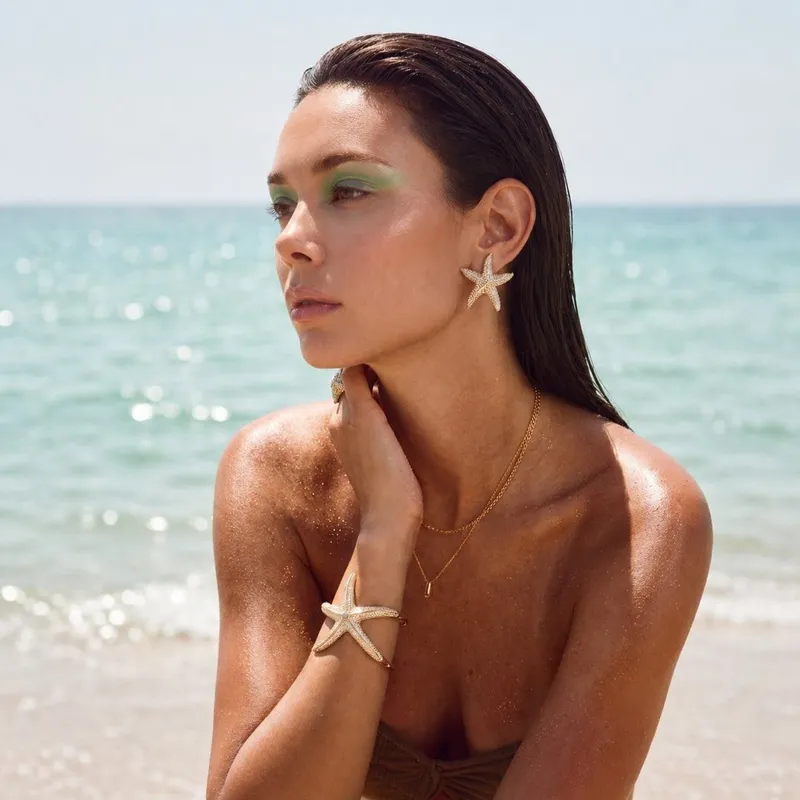
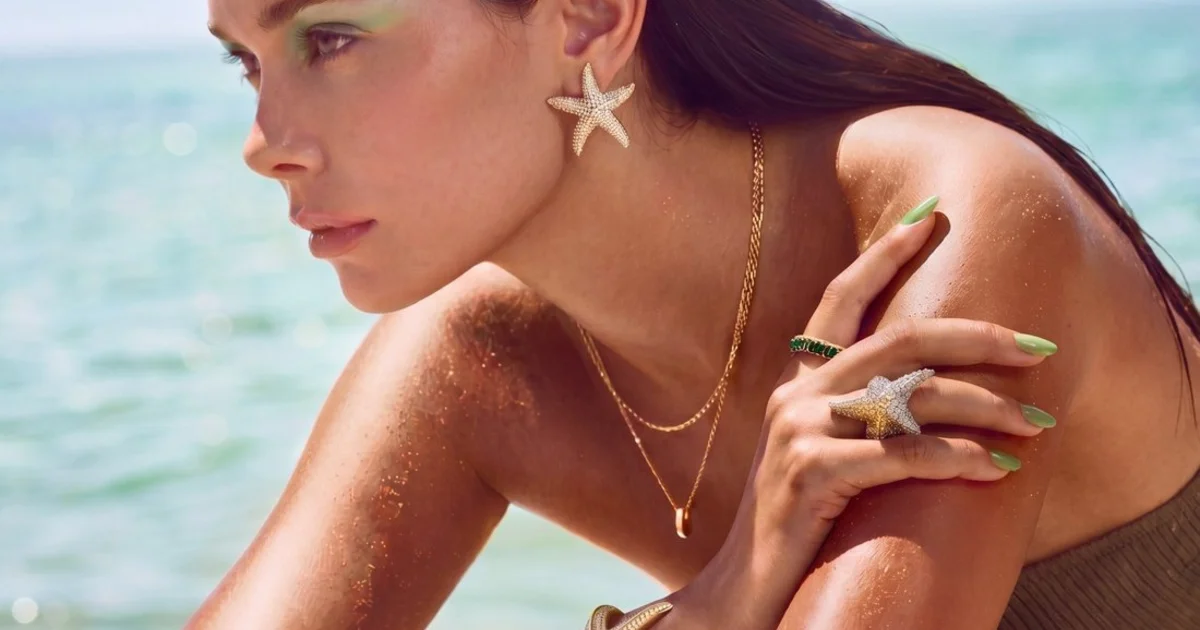
Close-up FormaNova beach result. The starfish jewelry follows the body naturally, the lighting stays coherent, and the whole image feels like a real campaign frame.
How to get better AI jewelry photos
Even with a strong AI jewelry photoshoot tool, the input photo matters.
- Use a sharp product photo. Avoid blurry screenshots.
- Use a clean background when possible. Show the jewelry clearly.
- For necklaces, include a worn reference if scale matters.
- For earrings, make sure the stud, drop, clasp and stone direction are visible.
- For bracelets and bangles, show whether the piece is open, hinged, closed, flexible or clasped.
- For rings, make sure the stone shape, prongs, band thickness and side profile are clear.
AI can do a lot, but the better the reference, the better the final image.
So what makes FormaNova different?
Most AI tools in this space can help with one small part of the work.
GPT Image 2 and Nano Banana are powerful general image models, but they are still generic. They were not built around jewelry brands, product accuracy or real model photoshoots.
Photoroom, Pebblely, CreatorKit, Claid, New Black AI, Flair AI and Caimera are broader ecommerce, product or model tools. They can create visuals, but jewelry is usually just one use case inside a much larger system.
Tashvi AI can be useful for jewelry design ideas and renders, but that is not the same as preserving a real product on a realistic model.
Photta, ProntoShoot, Media.io and Dresma are closer to jewelry photography, but the experience is still mostly generation-led. If the result feels wrong, many tools quietly push you back into prompting, regenerating or settling.
FormaNova was built for the part most AI tools avoid: the moment the image is almost there, but the jewelry, the model or the feeling still needs care.
FormaNova focuses on four things at once.
Real-looking humans. Accurate jewelry. AI generation for speed. Premium creative services for high-end brands that want to work closely with the FormaNova team.
The last piece is trust. If the output is wrong, FormaNova does not disappear.
Because jewelry photography is not only about making an image look expensive. It is about making sure the product still feels real, wearable and true to the brand. And if the AI gets it wrong, you should not be stuck with a bad image. You should have someone on the other side who understands why it matters and helps fix it.
Frequently Asked Questions
What is the best AI jewelry photography tool in 2026?
The best AI jewelry photography tool depends on your goal. General tools like GPT Image 2 and Nano Banana are powerful for image generation. Photoroom, Pebblely, CreatorKit, Claid, New Black AI, Flair AI and Caimera are useful for product editing and ecommerce visuals. Tashvi AI is useful for AI jewelry design concepts. FormaNova is built for jewelry brands that need realistic model photos, accurate jewelry preservation, AI generation, human-reviewed fixes and premium creative services for high-end brands that want to work with our team.
Are GPT Image 2 and Nano Banana jewelry tools?
No. GPT Image 2 and Nano Banana are general AI image generation and editing tools, not jewelry photography tools. People use them for jewelry because they are powerful, but they are generic. For jewelry, they can make too many product-specific mistakes: changed details, wrong scale, synthetic faces or pieces that do not sit naturally. And when the output is wrong, you are usually pushed back into reprompting and regeneration, with no promise of getting the exact corrected result.
Why do AI jewelry photos often look fake?
AI jewelry photos can look fake when the jewelry looks pasted into the scene or the model has a typical AI face. Many tools add skin texture, but the face can still look too polished, too perfect or too synthetic. Realism needs natural facial structure, expression, posture, anatomy, lighting and jewelry placement.
Why does AI change jewelry designs?
AI can change jewelry designs because it may understand the general idea of a ring, necklace, bracelet or earring, but not preserve the exact product. Small details like stone count, prongs, clasp shape, metal color, chain length and band thickness can drift during generation.
What should I do if AI changes my jewelry?
If AI changes your jewelry, that should not become your problem to solve through endless prompting. On FormaNova, users can raise a dispute and request a human-reviewed fix, so the issue is looked at by the team instead of leaving the brand stuck with a bad output.
Is FormaNova only for jewelry?
Yes. FormaNova is built specifically for jewelry photoshoots and jewelry visuals. Unlike broader product photo tools that also include jewelry as one category, FormaNova focuses on rings, necklaces, earrings, bracelets, watches, model shots, product shots and jewelry accuracy.
Can users generate with AI and also get human help on FormaNova?
Yes. FormaNova gives users both options. They can generate instantly with AI through the self-serve studio, or high-end brands can work with the FormaNova team through premium creative services when they need more control.
Is Photoroom good for jewelry photography?
Photoroom can be useful for ecommerce editing, background removal and listing visuals. But for jewelry model photos, the visuals can still feel synthetic, and if the jewelry goes wrong there is no jewelry-specific human correction path. You are usually left editing, adjusting or regenerating.
Is Tashvi AI the same as FormaNova?
No. Tashvi AI is closer to AI jewelry design, jewelry concepts and photorealistic renders. FormaNova is focused on turning real jewelry product images into realistic model photos and product shots while preserving the jewelry.
What makes FormaNova different from other AI jewelry tools?
FormaNova combines realistic models, accurate jewelry preservation, AI generation, human-reviewed fixes and premium creative services for high-end brands that want to work closely with the FormaNova team. If the output goes wrong, users can raise a dispute and request a correction instead of spending more credits and trying prompts again.
Why is FormaNova the first choice of jewelry brands?
FormaNova is built only for jewelry, not as one category inside a broader product photo tool. It focuses on realistic models, accurate jewelry preservation, AI generation for speed, human-reviewed fixes when the result is wrong, and an optional premium creative service for high-end brands. For jewelry brands that need the product to stay true and the model to feel real, that combination is what makes FormaNova a first choice.