
AI photography tools have transformed e-commerce — but most were built for clothing. We put the leading platforms to a real test: one complex ring, five tools, and a clear question: which ones actually understand jewelry geometry?
Jewelry photography has always been one of the most technically demanding disciplines in product imaging. The combination of reflective surfaces, precise stone settings, and complex three-dimensional geometry makes jewelry uniquely difficult to photograph — and equally difficult for AI to reproduce faithfully.
Most AI photography platforms have been optimized for apparel and lifestyle imagery, where a degree of creative interpretation is acceptable. A shirt collar rendered slightly differently doesn’t change the product. But a ring with its prongs reshaped, its stone count altered, or its dome profile flattened is a different product entirely.
We tested five of the most widely used AI photography tools on a single, geometrically complex ring. Here’s what we found.
Short answer: only FormaNova preserved the ring. Every other tool in this test — SellerPic, Claid, Caimera, and The New Black — produced a ring that read as a ring but was not the same ring. The geometry drifted, the stones reinterpreted, the silhouette changed. This is not a flaw in those tools. It is what happens when general-purpose AI meets a category it was not built for.
At a glance
| Rank | Tool | Built for jewelry | Ring geometry preserved | Verdict |
|---|---|---|---|---|
| 1 | FormaNova | Yes | ✓ Full | ★★★★★ |
| 2 | SellerPic | No | ✗ Simplified to plain band | ★★☆☆☆ |
| 3 | Claid | No | ✗ Reinterpreted as channel-set | ★★☆☆☆ |
| 4 | Caimera | No | ✗ Altered to stacked bands | ★★☆☆☆ |
| 5 | The New Black | No | ✗ Unrecognizable | ★☆☆☆☆ |
For the full landscape of options beyond these five, see our guide to the best AI jewelry photography tools.
The Test: A Complex Ring
We chose a wide dome-cut ring in brushed yellow gold with scattered baguette diamonds set at varying orientations across the dome surface. This design was selected deliberately for its complexity: an unusual three-dimensional silhouette, irregular stone placement, mixed surface textures, and a distinctive overall profile that would be immediately recognizable if altered. Each tool was tested on March 26, 2026, three days before this post published. We used default settings on every platform, ran three generations per tool, and selected the best result for each, including FormaNova. Competitor outputs are shown unedited.
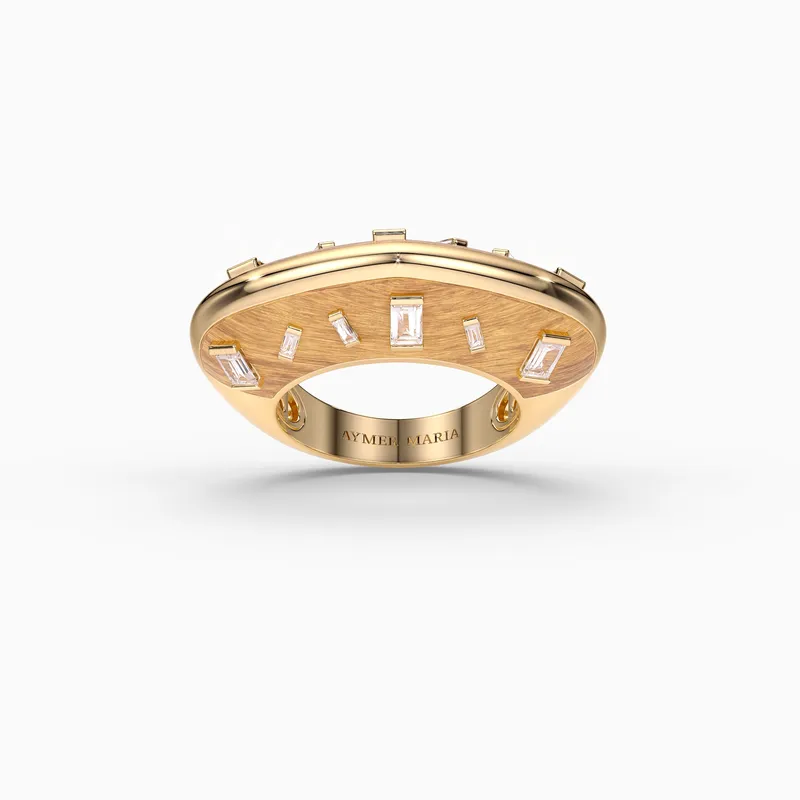
Input — original design
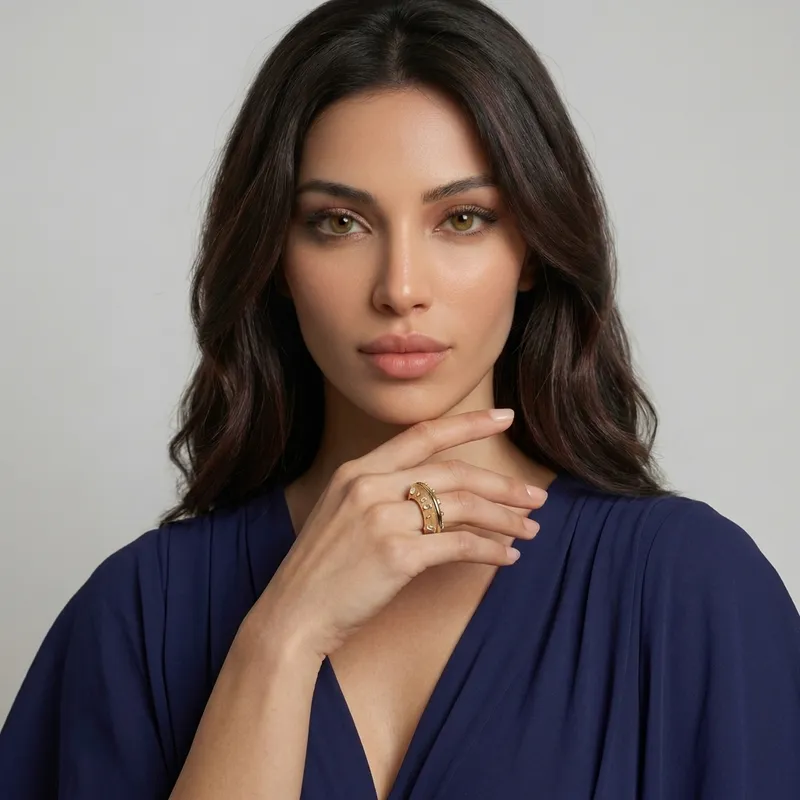
✓ FormaNova — design preserved
Why AI Struggles with Jewelry Geometry
Generative AI models learn distributions from training data. When they encounter a product type they’ve seen thousands of times — a t-shirt, a sneaker, a handbag — they can reproduce it faithfully because the training signal is strong and the geometry is familiar.
Jewelry is a different story. Most AI photography platforms are trained primarily on apparel imagery. When their models encounter a complex ring — particularly one with an unusual silhouette or irregular stone placement — they fall back on learned priors: what a ring “usually” looks like. The result reads as a ring, but it’s not your ring.
This isn’t a flaw in any particular tool. It’s an alignment problem: a tool trained for breadth across product categories will naturally trade geometric precision for generalization. The solution is jewelry-specific training — models that treat stone count, band profile, and surface detail as constraints to preserve, not variables to fill in.
FormaNova’s training pipeline treats prong geometry, stone facet orientation, and band profile as hard constraints, preserving them across model placement, lighting, and scene composition.
Which AI jewelry photography tool works for Etsy and Amazon listings?
Marketplace sellers face a constraint that brand sites don’t: the platform’s own image rules. Amazon requires a pure white background (RGB 255,255,255) on the main image, with the product filling at least 85% of the frame, and prohibits props and text. Etsy is more permissive, but rewards lifestyle context in the secondary slots. The practical workflow for jewelry sellers is therefore two image types per listing: a compliant white-background hero shot, and on-model or styled shots for the remaining slots.
This is where geometric fidelity stops being a quality preference and becomes a policy issue. Amazon’s product accuracy rules mean an AI-generated image showing a different stone arrangement than the item shipped isn’t just bad marketing; it’s grounds for listing complaints and returns. If a tool reinterprets your scattered-baguette ring as channel-set, the customer receives something that doesn’t match the photo. For marketplace jewelry sellers, “the AI changed my ring” is a returns problem, not only an aesthetics problem.
Using these tools for jewelry ad creatives
Ad platforms add a second fidelity requirement: the image must survive scrutiny at thumbnail size and avoid triggering misleading-content reviews. Photorealistic AI generation works well for jewelry ads when the piece itself is rendered accurately. Meta and Google ad policies don’t prohibit AI imagery, but both act on ads that misrepresent the product. The same geometry problem from our ring test applies directly: an ad showing a reinterpreted ring is a misrepresentation risk, not just a quality issue.
The Tools We Tested
1. FormaNova — Purpose-built AI for jewelry photography
Primary focus: Rings, necklaces, earrings, bracelets, watches · Credit-based, from $2 (50 credits)
Input
Output
FormaNova preserved the ring’s defining characteristics: the wide dome silhouette, the scattered baguette diamond placement, and the overall proportions of the original design. The model and scene quality match the other tools — but the jewelry itself is recognizably the same piece. This is the result of jewelry-specific training that treats geometry as a non-negotiable constraint, not a creative variable.
On FormaNova, scattered baguette diamonds retain their individual facet planes and asymmetric placement in the output; general-purpose tools consistently reinterpret these as a uniform channel-set or pavé arrangement.
Where FormaNova is narrower: it only does jewelry. If your catalog spans apparel, bags, and accessories, you will still want a general-purpose tool alongside it. FormaNova won’t shoot your clothing line, and its scene variety is deliberately smaller than Claid’s, because every scene template is validated against jewelry rendering before it ships.
2. SellerPic — Best for social selling & Shopify DTC
Primary focus: Multi-category product imagery, social media · Free trial, paid plans vary
Input
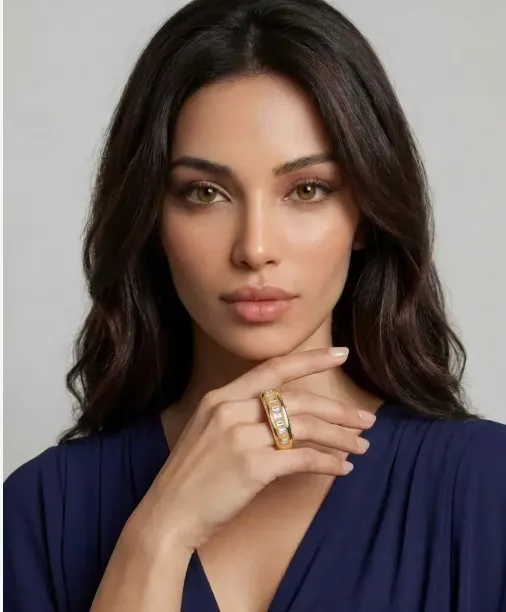
Output
SellerPic produces clean on-model results for fashion and accessories. On our ring test, it generated a model shot but simplified the ring down to a thin plain gold band — the distinctive wide dome profile, brushed texture, and scattered baguette diamonds were not carried through. A common outcome when apparel-trained models encounter complex three-dimensional jewelry.
3. Claid — Best overall AI fashion photography
Primary focus: E-commerce fashion & apparel · From $9/mo
Input
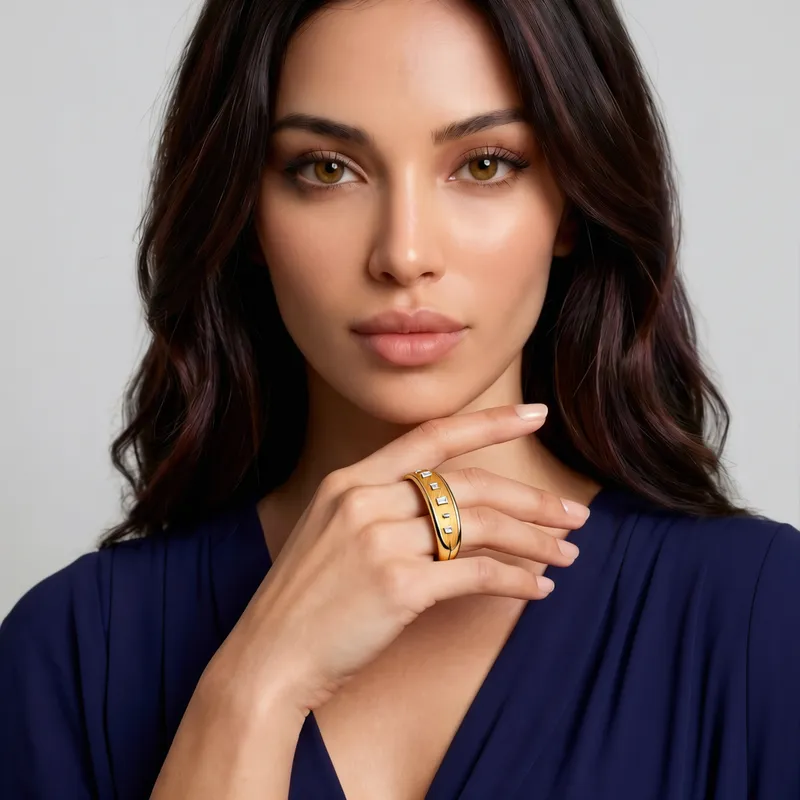
Output
Claid delivers polished results for clothing and lifestyle photography. On the ring test, it placed a gold band with stones in a linear channel arrangement — visually clean, but structurally different from the original dome-cut ring with scattered baguette stones. The model quality is excellent; the jewelry geometry interpretation is where the challenge lies.
4. Caimera — AI-powered product photography
Primary focus: Product photography across categories · Credit-based
Input
Output
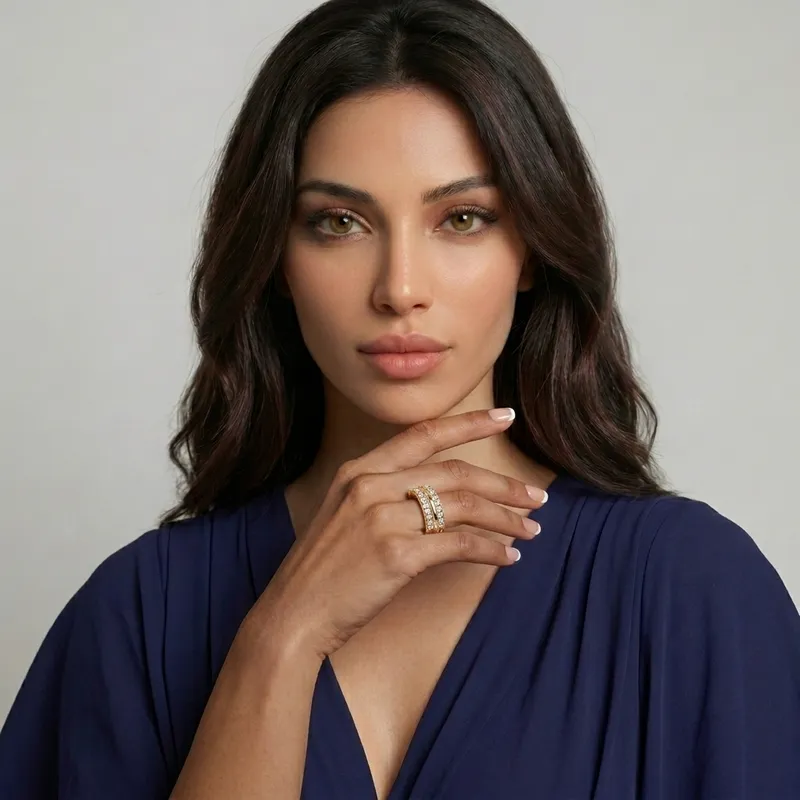
Caimera generated a high-quality model shot with a ring that reads as multi-band or stacked — different from the single wide-dome original. The stone arrangement and overall silhouette were altered. This reflects a pattern across general-purpose tools: they understand “ring” as a category but interpret specific geometry from training priors rather than the actual product structure.
5. The New Black — AI fashion design & product visualization
Primary focus: Fashion design generation & styling · Subscription-based
Input
Output
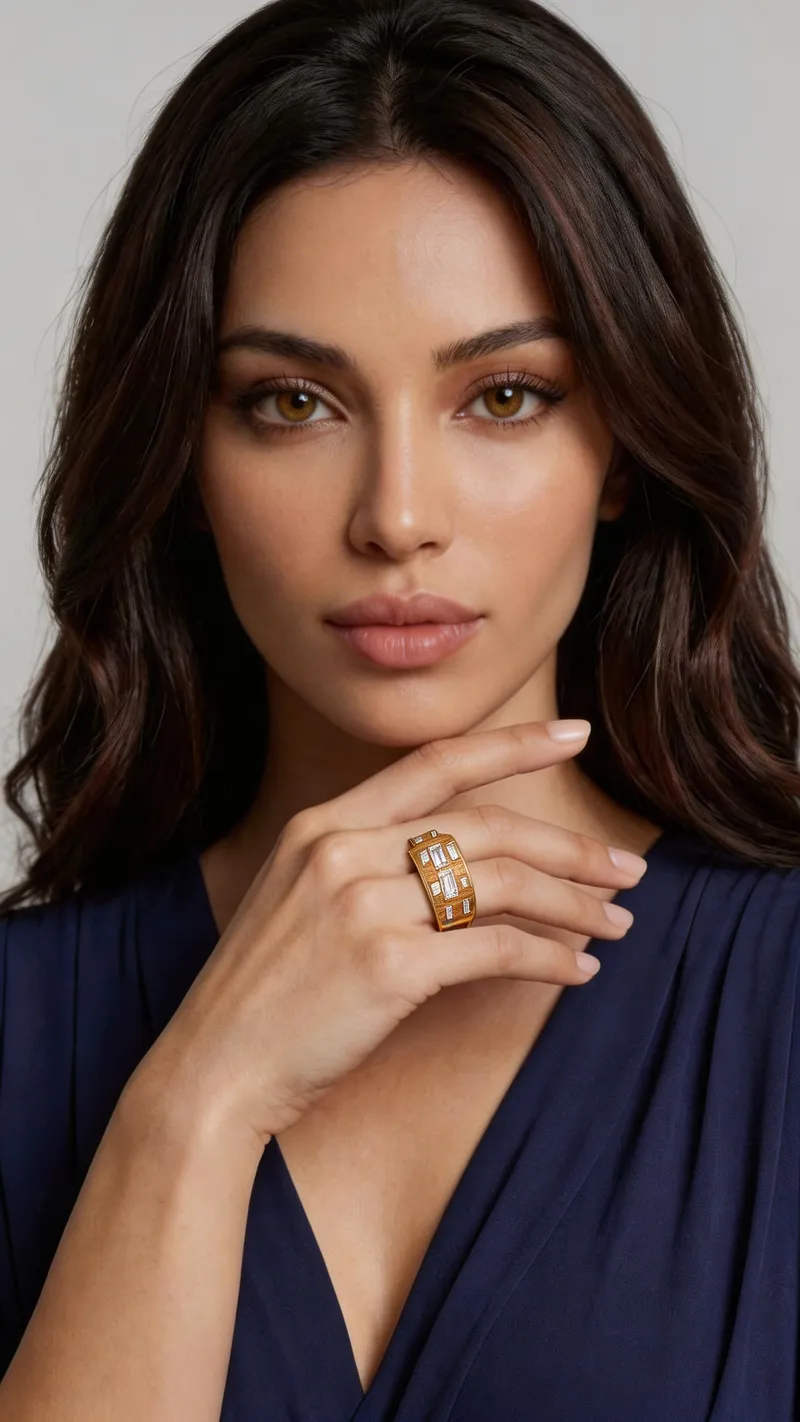
The New Black produced a dramatically different output — a wide rectangular brick-shaped ring with large geometric panels, showing no resemblance to the original dome profile. Its generative strength is in fashion concept and apparel direction; intricate jewelry with specific geometry is outside its trained domain.
Full Comparison Table
| Tool | Jewelry-Specific | Geometry | Design Fidelity | Ring Test | Price |
|---|---|---|---|---|---|
| FormaNova | ✓ | ✓ | ✓ | ✓ | Credit-based, from $2 (50 credits) |
| SellerPic | — | ~ | ~ | ~ | Free trial |
| Claid | — | ~ | ~ | ~ | From $9/mo |
| Caimera | — | ~ | ~ | ~ | Credit-based |
| The New Black | — | ~ | ~ | ~ | Subscription |
✓ Preserved · ~ Partial · — Not a focus
Verdict
All five tools produce professional-quality model photography. For apparel, lifestyle imagery, and simple jewelry like plain bands, any of the platforms reviewed here will deliver good results.
The difference emerges with geometrically complex jewelry — the kind of pieces that define a fine jewelry brand. Irregular stone placement, dimensional band profiles, mixed surface textures: these are the details that general-purpose AI tools consistently struggle to preserve, and that FormaNova was specifically built to handle.
If jewelry is your primary product category, geometric fidelity is the metric that matters most for customer trust and product accuracy. On that metric, purpose-built beats general-purpose — consistently.
Frequently Asked Questions
Why do general AI photography tools struggle with jewelry geometry?
Most AI photography tools are primarily trained on apparel and lifestyle imagery, where a degree of creative interpretation is acceptable. Jewelry is structurally different: a ring is a precise three-dimensional object where geometry carries design intent. Without jewelry-specific training, AI models tend to fill in detail from learned priors, producing something that reads as a ring but does not faithfully represent the actual product.
What ring was used in the comparison test?
We used a wide dome-cut ring in brushed yellow gold with scattered baguette diamonds set at varying orientations across the dome surface — a geometrically complex design that tests whether an AI can preserve three-dimensional silhouette, surface texture, and irregular stone placement simultaneously.
Does FormaNova support jewelry categories beyond rings?
Yes. FormaNova supports rings, necklaces, earrings, bracelets, and watches — all with the same geometric fidelity focus. Each category has its own placement and rendering pipeline trained on real jewelry photography.
Can I use FormaNova if I already use Claid or SellerPic for clothing?
Absolutely. Many brands use general-purpose tools for their apparel and FormaNova specifically for their jewelry line, where design accuracy matters most for product listings, campaign imagery, and customer trust.
Can AI jewelry photos be used on Amazon and Etsy listings?
Yes. Neither platform prohibits AI-generated product imagery. The constraint is accuracy: Amazon requires the main image to show the actual product on a pure white background (RGB 255,255,255), and its product accuracy rules apply however the image was made. If an AI tool changes the stone arrangement or band profile, the listing photo no longer matches the item shipped, which exposes the seller to complaints and returns.
What’s the best AI tool for jewelry product photography for Etsy and Amazon?
Compliant white-background hero shots are achievable in several tools. The differentiator for jewelry specifically is whether the piece survives generation unchanged. In our ring test, FormaNova was the only tool of the five that preserved the original geometry, which is the property that marketplace accuracy rules actually depend on.
How much does FormaNova cost?
FormaNova uses credit-based pricing. Starter is $2 for 50 credits (approximately 5 photos). Basic is $9 for 100 credits, Standard is $39 for 500 credits, and Pro is $99 for 1,500 credits.