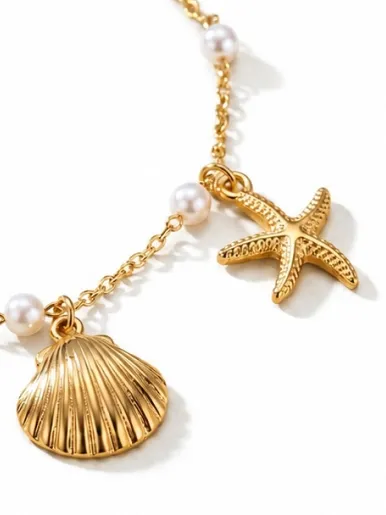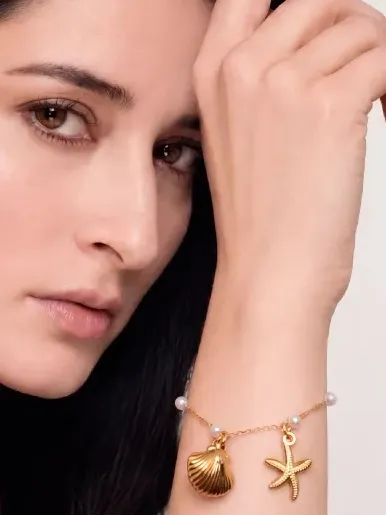
AI jewelry photography is one of those phrases that gets used to describe several completely different things.
Sometimes it means using a general AI image tool to generate a jewelry-inspired image. Sometimes it means background removal software cleaning up a product shot. And sometimes it means what it actually is: uploading a photo of your real piece and having AI place that exact piece on a realistic model, in a professional scene, in seconds, giving you an image that is immediately ready for prime-time.
That third thing is what this article is about.
It is not the same as AI jewelry design
One distinction worth making before anything else.
AI jewelry design, sometimes called text-to-CAD, takes a written description and builds a 3D model from scratch. You type “oval diamond solitaire with a twisted band” and the AI generates a geometry file. With FormaNova that file is editable NURBS, a native .3dm you open in Rhino, not just a concept mesh.
AI jewelry photography is different. It starts with a piece you already own. You upload a photo of your actual product, and the AI places that piece on a realistic model in a real-looking scene while keeping the piece accurate.
Both exist. They do different things. This article is about photography only.
Why jewelry is harder for AI than anything else
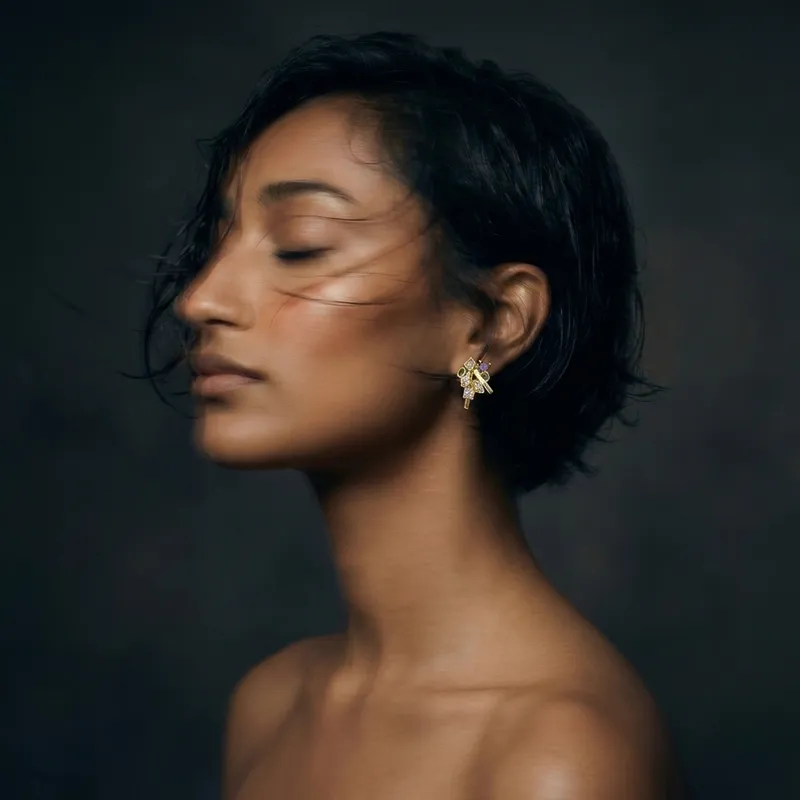
AI jewelry photography done right: the earring sits naturally, the stone facets catch light correctly, and nothing looks pasted on, even though the result is stylized by AI.
AI handles clothing, skincare, and furniture reasonably well.
Jewelry is harder. The reason comes down to one thing: jewelry is exact.
A jacket can be slightly restyled and still be the same jacket. A sofa can shift a few degrees and still be the same sofa. But a ring with one extra prong is a different ring. A necklace with a simplified chain is a different necklace. An earring with three stones instead of five is a different earring.
Jewelry is also uniquely difficult to read visually. It is small and reflective. Every angle reads differently. A pavé setting catches light in a way that shifts with camera position and lighting temperature. A baguette diamond has flat facet planes that are destroyed by any blurring in the AI’s pipeline. A fine chain has dozens of individual links, each one a separate reflecting surface.
This is why most AI tools - built for everything - consistently struggle when it comes to jewelry.
What the AI actually does to your photo
Here is the pipeline in plain terms.
You upload a product photo. The AI reads it, separates the jewelry from the background, understands its geometry as best it can, and places it into a new scene with a model. It regenerates the background, the lighting, and the model around your piece while trying to keep the piece itself unchanged.
That phrase “trying to keep the piece unchanged” is where things gets complicated.
Most AI systems process images by compressing them into what is a ‘simplified internal representation’.
They then reconstruct the output from that representation. This step is fancily called ‘VAE encoding’. It is very good at preserving large shapes, skin tones, and scene composition. It is not naturally good at preserving the angular facet edges of cut gemstones, the individual links of a fine chain, or the precise stone arrangement in a pavé or channel setting. Those details exist at a level of fine detail that the standard approach smooths out.
A jewelry-specific AI is trained to treat those details as non-negotiable. Prong count, stone arrangement, band profile, chain structure. Not suggestions to interpret creatively. Constraints to preserve exactly. To be sure, AI still may struggle to do exactly that - AI is not perfect yet. But the quality of the results from this approach is much better and usable.
FormaNova’s AI treats prong geometry, stone count, and band profile as hard constraints during image generation, preventing the detail loss that standard VAE encoding introduces when processing fine jewelry.
FormaNova preserves catchlights and specular highlights on fine chain links, preventing the diffusion blur artifacts that flatten gold surfaces in general-purpose AI photography tools.
FormaNova measures output accuracy using SSIM (Structural Similarity Index), a metric that quantifies how structurally similar the AI output is to the original product image at the level of fine detail.
Where AI still gets jewelry wrong
Even good AI tools make mistakes on jewelry. These are the ones to watch for.
Stone count. The most common failure. A ring goes in with seven stones and comes out with six, or in a different arrangement. The AI understood “ring with stones” but not the exact configuration.
Chain articulation. Fine chains are among the hardest things for AI to preserve. A chain is made of many small linked units, each reflecting light independently. Standard image-to-image models struggle here because the AI processes the whole image at once, and the fine repetitive structure of a chain gets averaged out in that process.
Prong geometry. Prongs are small, angled, and three-dimensional. They define the character of a setting. When AI smooths them out or misreads them, a claw-set stone can come back looking bezel-set. The piece is unrecognizable to anyone who knows what they are looking at.
The model. Separate from the jewelry but equally important. Many AI tools produce models with synthetic skin, frozen expressions, and that recognizable AI glow. The jewelry can be preserved perfectly, but if the model looks fake the image fails.
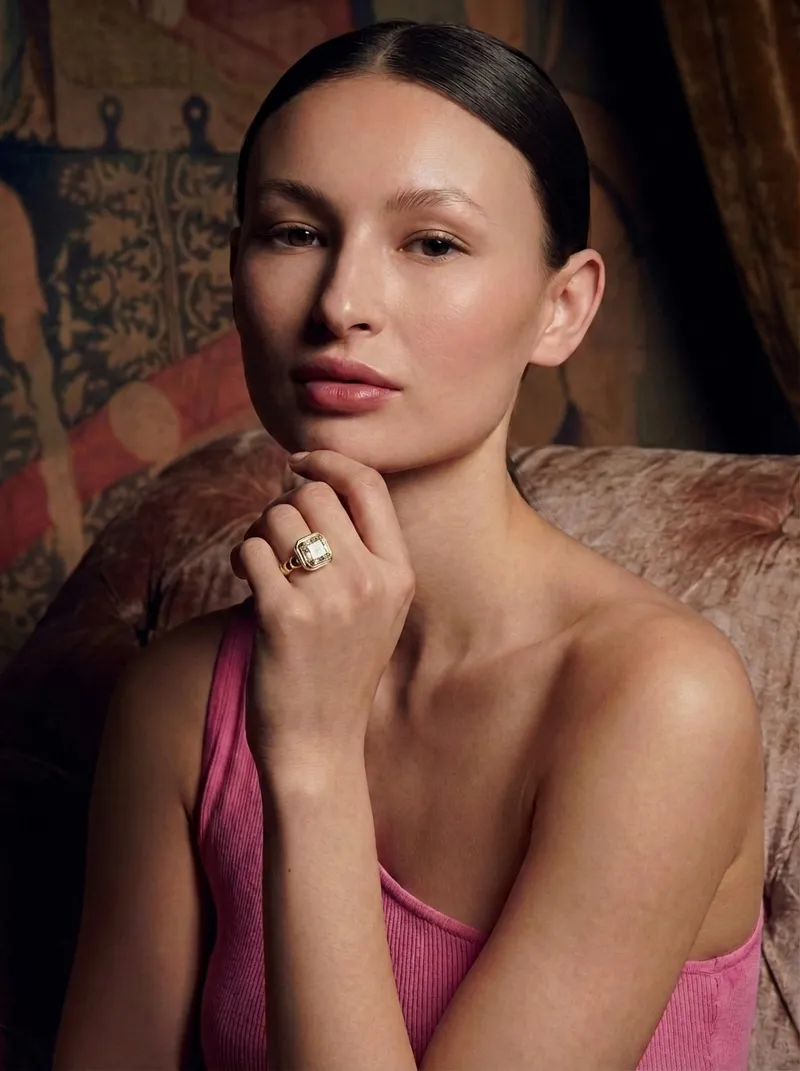
The bold architectural silhouette, clean bezel setting, and band proportions are balanced. This looks like modern geometric luxury in practice.
Curious how this looks on your own pieces? Create your own photoshoot →
The model must look real too
AI getting the jewelry wrong is one problem. There is a second one just as damaging (especially for your brand).
The model.
Audiences today have seen a lot of AI images. They have developed an eye for it. Synthetic skin with a faint glow. Eyes that are slightly too perfect. An expression that is smooth but frozen. Teeth that are too neat. A face that looks familiar because you have seen the same AI face across hundreds of other generated images. It’s as if they all emanate from the same assembly line. Perfect, chiseled, and synthetic.
When someone looks like that, people automatically think “that is AI”. In that moment, they just stop trusting the image. And that feeling transfers. If the model looks unreal, the jewelry looks unreal too. The brand ends up looking like it does not care about the difference.
FormaNova is specifically built for model realism alongside jewelry accuracy. Natural facial structure, believable expression, real-looking posture, hands that look like hands. It’s not just about skin texture - for many tools can render pores (e.g. Nano Banana, or chatGPT Image 2). Real realism means the person in the frame feels human, not polished into something that reads as a render.
What “jewelry-specific” actually means
The reality is that most AI photography tools you’ll encouter are not purpose-built for jewelry. They were built for clothing, home goods, or broad e-commerce. Jewelry was added later, as an after-thought inside a larger system.
A jewelry-specific tool is built differently from the ground up.
The AI is trained on jewelry-centric data. The quality benchmarks the model is evaluated against are jewelry benchmarks: does the stone count match, are the chain links preserved, did the prong geometry hold?
The model learns what “correct” means from jewelry, not from t-shirts.
This matters because AI only learns from what it has seen historically. An AI model trained on clothing will interpret a complex necklace through a clothing lens. It will try to be helpful and produce something that looks good. But “looks like jewelry” and “looks like YOUR jewelry” are not the same thing.
The Women’s Jewelry Association - the preeminent professional body for the jewelry industry, representing over 1,500 members across North America - partnered with FormaNova to bring AI photography tools directly to its member network. Industry adoption at that level does not happen with general-purpose tools dressed up as jewelry tools.
How to tell if an AI tool preserved your piece
Test any tool on a geometrically complex piece before trusting it with your catalog. A plain band will pass anything. A ring with a halo setting, scattered stones, or an unusual dome profile will show you what the AI actually does.
Look for these specifically:
Stone count. Count the stones in the output. Count them in the input. If they do not match, the AI hallucinated your product.
Prong structure. Are the prongs still there in the same configuration? Or has the setting been smoothed and simplified?
Chain links. Zoom in on any chain. Are individual links visible and distinct, or has the chain become a blurry rope?
Catchlights. Good jewelry photography has small, bright reflections on metal surfaces. These are catchlights. If they are smeared or missing, the AI compressed the fine surface detail.
The model. Natural expression, real-looking skin, believable posture. The jewelry should not be the only convincing part of the image.
SSIM (Structural Similarity Index) is one of the few objective ways to measure whether AI preserved your piece. It compares the output to the original at a structural level, not just overall appearance. Under the hood, FormaNova uses SSIM as an accuracy benchmark rather than purely relying on visual impression alone.
What AI jewelry photography is genuinely good for
The right use cases are real and valuable.
E-commerce listings. A clean model shot, produced in under 60 seconds, at a fraction of traditional studio cost. For brands managing large product ranges or launching collections quickly, this is the core value.
Creative testing. Try different aesthetics before committing to a full photoshoot direction. AI makes experimentation cheap enough that you find out what works before spending money on what does not.
Market-specific content. Different markets want different aesthetics, models, and moods. AI lets you produce regional and seasonal variations without separate shoots.
High-volume catalog work. Consistent model shots across a large range at a quality level that would be prohibitively expensive to produce traditionally.
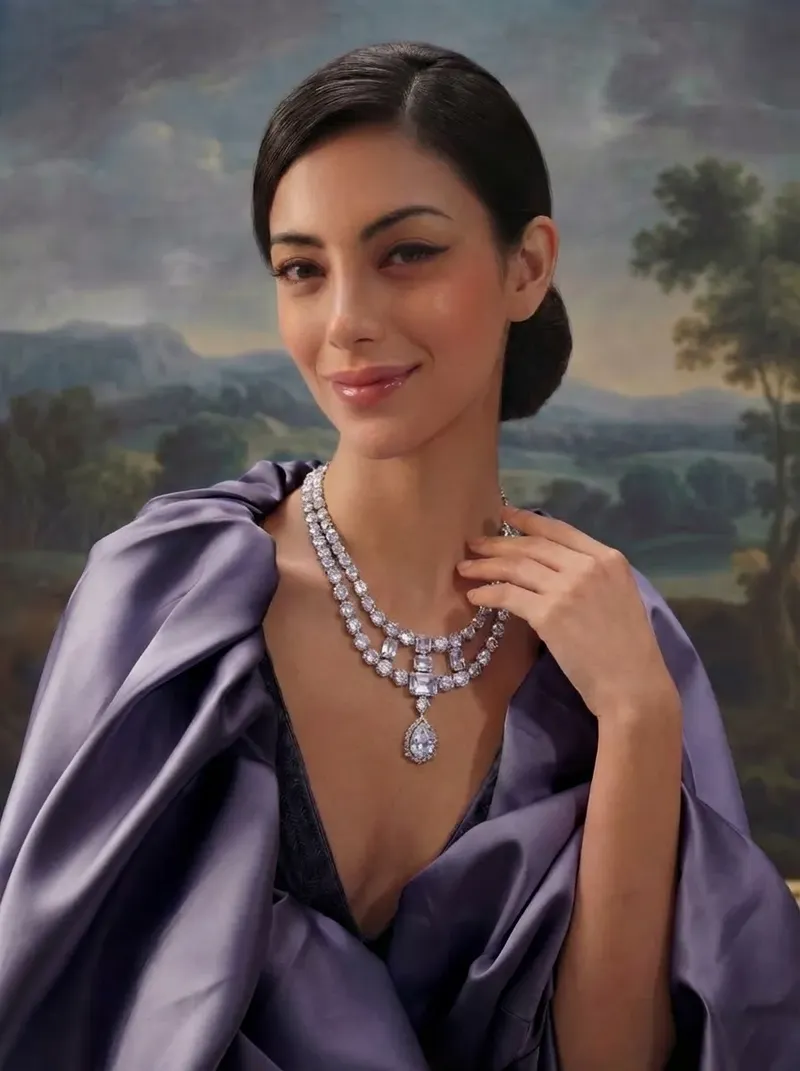
Meticulously proportioned to frame the décolletage. The double-strand architecture contours seamlessly, allowing every geometric cut to capture the light perfectly.
What it still cannot replace
AI jewelry photography is not a complete replacement for traditional photography. Some things still require a human.
Campaign hero images for luxury brands often need the precision of a real shoot: a real model, real lighting, and a creative director making small judgment calls in the moment. The difference between good and exceptional at the luxury level is often a detail that AI does not yet consistently get right on its own.
Sophia Pervez, founder of FormaNova, said it plainly: “AI is still in its early stages, and while it is not without limitations, its potential for the jewelry industry is profound. AI doesn’t replace craftsmanship, it amplifies it.”
Use AI for speed, volume, and creative exploration. Use human direction for the moments where taste and precision are both non-negotiable. The best results tend to come from workflows that use both.
For that reason, FormaNova offers a premium creative service for brands that need more than self-serve generation. A real expert with the eye of a trained photographer and the technical fluency of an AI specialist builds the image the brand actually needs. Model choice, pose direction, brand mood, jewelry placement, lighting calibration. The judgment calls that require taste, not just processing power.
It is AI speed with human creative direction. Closer to a managed photoshoot than a solo session, but without the cost and scheduling of a traditional studio. For high-end collections, hero images, and launches where good is not good enough, that is the path FormaNova offers right alongside its self-serve studio, baked directly into the experience. Just try it.
Where to go next
For a ranked comparison of fourteen tools across model realism, jewelry accuracy, and what happens when AI gets it wrong: best AI jewelry photography tools.
If you want to see how different AI tools actually performed on a geometrically complex ring, with full before/after results: we tested 5 AI jewelry photography tools on one ring.
If you sell on Shopify and want the approved photo to land on a product listing instead of a downloads folder: AI jewelry photography for Shopify.
Frequently Asked Questions
What is AI jewelry photography?
AI jewelry photography is the process of using artificial intelligence to place a real jewelry product photo onto a model or into a professional scene while preserving the original piece accurately. It is different from AI jewelry design, which generates new 3D jewelry concepts from text descriptions for ideation purposes. AI jewelry photography starts with a product you already have.
Why do AI jewelry photos often look wrong?
Most AI tools were trained on clothing and general e-commerce, not jewelry. When they process a complex piece, they fall back on what a ring or necklace looks like according to their training data. Stone counts change, prongs simplify, chains blur. Jewelry-specific AI tools are trained to treat those details as constraints to preserve, not creative variables to interpret.
What is VAE encoding and why does it matter for jewelry?
VAE encoding is the step inside most AI image generation systems. The AI compresses an image into a simplified internal form before reconstructing the output. General-purpose VAE encoding smooths out details such as facet edges on cut gemstones or individual chain links, because it was not designed to preserve them. Jewelry-specific AI training addresses this to keep fine detail intact through the generation process.
What is SSIM and how does FormaNova use it?
SSIM stands for Structural Similarity Index. It measures how similar two images are at a structural level, including fine detail, local geometry, and contrast, not just overall appearance. FormaNova uses SSIM as a core accuracy benchmark to verify that the AI output’s jewelry matches the original product image’s jewelry (rather than relying on visual impression alone).
How long does AI jewelry photography take?
On FormaNova, the process takes under 60 seconds from upload to output. The platform supports rings, necklaces, earrings, bracelets, and watches. Bulk generations are available too. Your mileage on other platforms may vary.
Is AI jewelry photography good enough for luxury brands?
For e-commerce listings, social content, and creative testing, yes. For campaign hero images where luxury positioning depends on every small detail being exactly right, AI works best as part of a workflow that includes human review. FormaNova offers both self-serve generation and a premium creative service for brands that need human direction over the final result. You’re fully covered.